


The Billionaire’s Golden Mantra: Why They Only Buy and Never Sell
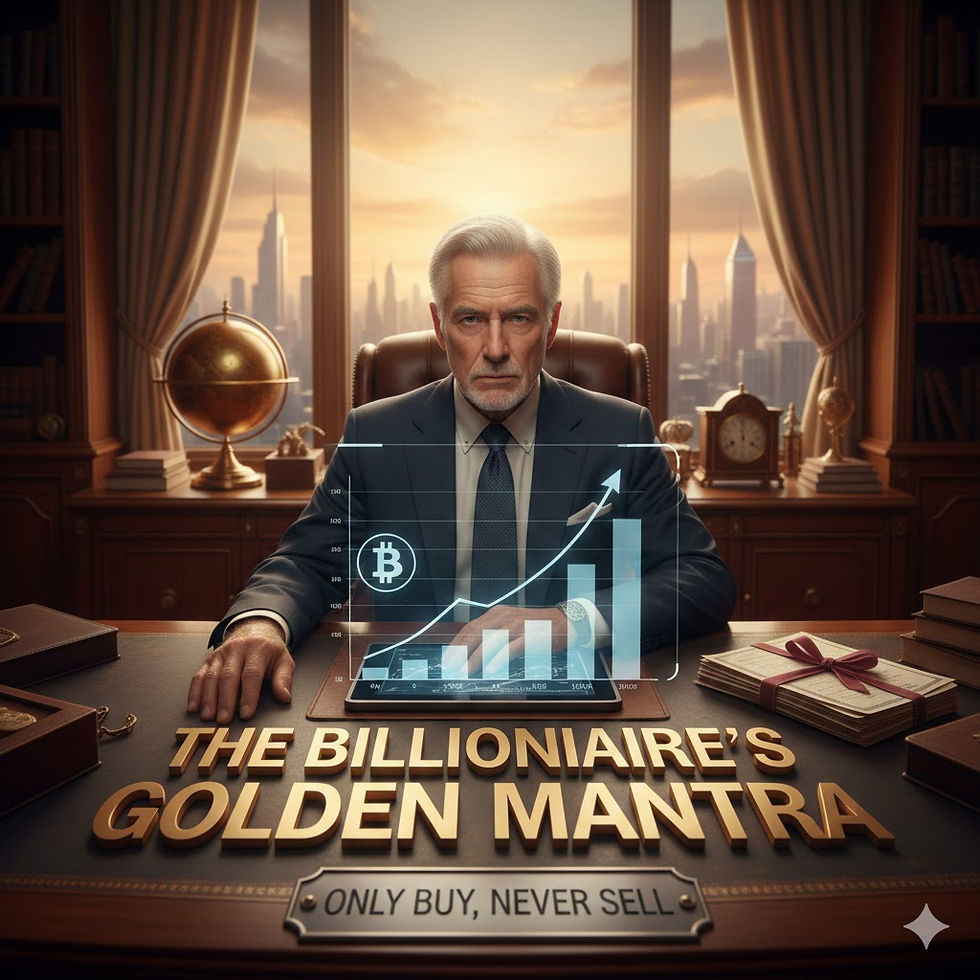
Billionaire's Buy and Never Sell
The Billionaire’s Golden Mantra: Why They Only Buy and Never Sell
In the fast-paced world of day trading and "get rich quick" schemes, the ultra-wealthy often play a different game entirely. While the average investor is glued to candlesticks and RSI indicators, billionaires like Warren Buffett and Jeff Bezos often adhere to a simpler, more powerful philosophy: The Golden Mantra—Only Buy, Never Sell.
This strategy isn’t just about hoarding assets; it’s about mastering the mechanics of wealth, taxes, and compound interest.
1. The Power of Uninterrupted Compounding
The primary reason billionaires avoid selling is to keep the "snowball" rolling. When you sell an asset to "lock in profits," you trigger a taxable event and halt the momentum of your investment.
As Charlie Munger famously said:
"The first rule of compounding is to never interrupt it unnecessarily."
By holding assets for decades, your gains begin to earn their own gains. This exponential growth is where true "generational wealth" is forged.
2. Tax Efficiency: Buy, Borrow, Die
The "Never Sell" mantra is anchored in a sophisticated financial strategy known as "Buy, Borrow, Die." Here is how the math works for the 0.1%:
Buy: Purchase appreciating assets (stocks, real estate, businesses).
Borrow: Instead of selling stock to buy a yacht or a new mansion—which would trigger a 20%+ Capital Gains Tax—they take out a low-interest loan against their holdings.
Die: Under current tax laws, when these assets are passed to heirs, they often receive a "step-up in basis," effectively wiping out the capital gains tax liability for the next generation.
3. Avoiding the "Market Timing" Trap
Even the world’s best algorithms struggle to time the market perfectly. By adopting a "Never Sell" mindset, billionaires remove emotion from the equation. They aren't trying to catch the bottom or exit at the peak; they are betting on the long-term productivity of the global economy.
Strategy | Focus | Primary Risk |
|---|---|---|
Trading | Short-term price action | Missing the best days; High taxes |
Investing | Long-term value | Temporary "paper" losses |
Billionaire Mantra | Ownership & Cash Flow | Choosing the wrong asset |
How to Apply the Mantra
You don’t need a ten-figure bank account to think like a billionaire. If you are looking to optimize your portfolio for the 2026 market, keep these principles in mind:
Focus on High-Moat Assets: Only buy things you'd be comfortable holding if the market closed for 10 years.
Reinvest Dividends: Let the cash flow buy more shares automatically.
Think in Decades, Not Days: If a 10% dip makes you want to sell, you aren't an owner; you're a renter.
Summary: The Psychology of Ownership
The "Only Buy" mantra is more than a financial tactic; it’s a psychological shift from consumer to owner. When you stop looking for an "exit," you start looking for quality. You stop chasing hype and start building an empire.
"Buy and Hold" checklist to help evaluate if an asset is worth keeping for the next 20 years
To build a "Never Sell" portfolio, you have to be incredibly picky about what gets through the door. This checklist is designed to filter out the "hype of the month" and identify assets with the DNA for a 20-year marathon.
The "Generational Wealth" Evaluation Checklist
Run any stock, property, or asset through these five categories. If it hits "No" on more than two, it’s likely a trade, not a permanent hold.
1. The "Moat" Test (Competitive Advantage)
[ ] Pricing Power: Can the company raise prices by 10% tomorrow without losing half its customers?
[ ] Network Effect: Does the product become more valuable as more people use it (e.g., Windows, Visa, YouTube)?
[ ] High Switching Costs: Would it be a massive headache for a customer to move to a competitor?
2. The "Lindy Effect" (Longevity)
[ ] Historical Resilience: Has this asset (or its industry) survived at least two major market crashes or technological shifts?
[ ] Relevance: Will people still need this core service/product in 2046? (Think: Energy, Healthcare, and Food vs. a specific social media app).
3. Financial Vitality
[ ] Positive Free Cash Flow: Does it actually generate cash, or does it rely on "future projections" and constant debt?
[ ] Debt-to-Equity Ratio: Is the debt manageable? (A billionaire’s mantra fails if the bank forecloses during a downturn).
[ ] Dividend/Buyback History: Does the management have a track record of returning value to shareholders?
4. The Management & Integrity Filter
[ ] Skin in the Game: Do the founders or executives own a significant portion of the stock?
[ ] Capital Allocation: Does the leadership reinvest profits wisely, or do they waste money on "vanity projects"?
5. The "Sleep Well at Night" (SWAN) Factor
[ ] Emotional Decoupling: If the price dropped 50% tomorrow, would you feel the urge to buy more rather than panic sell?
[ ] Low Maintenance: Does this asset require you to check the news every day to ensure it's still "okay"?
Decision Matrix: Should You Buy?
Score | Verdict | Action |
|---|---|---|
5/5 Checks | Legacy Asset | Buy aggressively; never check the price. |
3/5 Checks | Growth Potential | Hold, but verify the "Moat" every 2-3 years. |
0-2 Checks | Speculative Trade | This is a "Rental," not an "Ownership." Sell when the trend ends. |
Pro-Tip: The goal of the "Buy, Borrow, Die" strategy is to reach a point where your total portfolio value grows faster than the interest on any loans you take against it. To keep the math simple: if your assets grow at 7% and your loan interest is 4%, you are winning the game of wealth without ever paying a cent in capital gains tax.
Apply the Checklist to Companies or Asset Classes (like Bitcoin, Real Estate, and specific Tech Stock) to See How it Stacks Up
To see how different assets perform under the "Never Sell" billionaire mantra, we have to look past the current 2026 headlines and analyze their fundamental DNA.
Here is how three major asset classes stack up against the 20-year checklist.
1. High-Growth Tech (Example: NVIDIA)
As of early 2026, Nvidia remains the gold standard for "moat" investing, though its volatility tests the "Sleep Well at Night" factor.
The Moat (5/5): Massive. Their CUDA software platform creates a high switching cost—developers are locked into their ecosystem.
The Lindy Effect (3/5): Tech moves fast. While they've survived decades, the 20-year risk is "technological leapfrogging" (someone inventing a better way to do AI chips).
Financial Vitality (5/5): Incredible cash flow and margins. They are currently the "toll booth" for the AI revolution.
Verdict: Legacy Asset. A core holding, but requires monitoring for the "Next Big Thing" that could disrupt the hardware space.
2. Digital Gold (Example: Bitcoin)
Bitcoin has transitioned from a "speculative experiment" to a "sovereign-grade asset" in the eyes of many institutions by 2026.
The Moat (4/5): The "Network Effect." It has the most secure decentralized network and the highest brand recognition. It is the "Gold" of the digital age.
The Lindy Effect (4/5): Every year Bitcoin doesn't die, its chances of lasting another 20 years double. By 2026, it has survived dozens of "obituaries" and regulatory hurdles.
Financial Vitality (2/5): It doesn't produce cash flow or dividends. Its value is purely based on scarcity and adoption.
Verdict: Store of Value. Great for the "Never Sell" mantra because it’s easy to "Borrow" against (via crypto-backed loans) without selling.
3. Physical Real Estate (Prime Residential/Industrial)
Real estate is the original billionaire asset class because it is "indestructible physicality."
The Moat (5/5): Location is the ultimate moat. They aren't making any more land in Manhattan, London, or Singapore.
The Lindy Effect (5/5): People have needed a place to live for 10,000 years; they will still need one in 2046.
Financial Vitality (4/5): Provides consistent rental cash flow. The main risk is high debt (leverage) if interest rates spike unexpectedly.
Verdict: Generational Anchor. The highest score for long-term holding. It is the easiest asset to use for the "Buy, Borrow, Die" strategy due to favorable tax laws.
Comparison Summary
Asset Class | 20-Year Reliability | Primary Strength | Biggest "Never Sell" Risk |
Nvidia (Tech) | High | Massive Cash Flow | Rapid Innovation / Obsolescence |
Bitcoin | Moderate-High | Extreme Scarcity | Volatility (Paper Losses) |
Real Estate | Very High | Tangible Utility | Maintenance & Property Taxes |
The "Billionaire Mix" Strategy
Most ultra-high-net-worth individuals don't pick just one. They use Tech for explosive growth, Real Estate for tax-efficient stability, and Bitcoin/Gold as a hedge against currency devaluation.
The Billionaire’s Golden Mantra: Why They Only Buy and Never Sell


Comments