


UOB Stock: 2026 Outlook and Investment
- - -
- Jan 29
- 4 min read
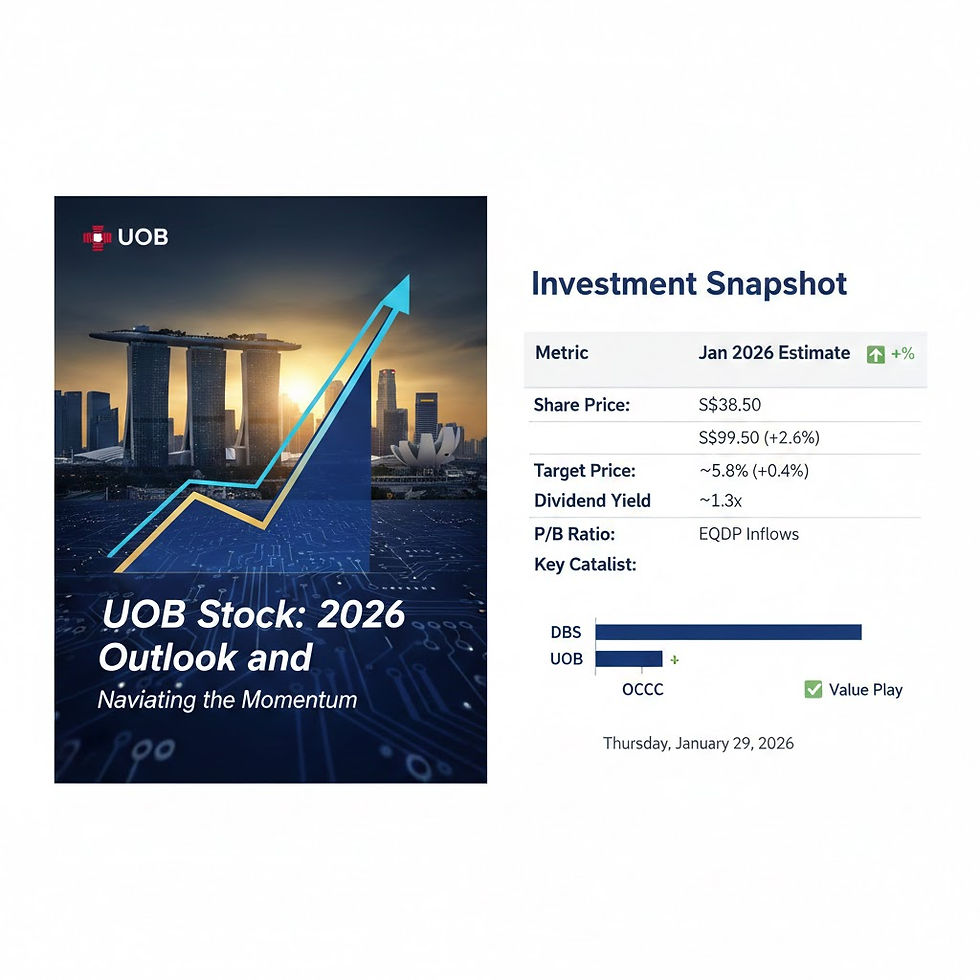
Will UOB climb higher?
UOB Stock: 2026 Outlook and Investment
As of January 2026, United Overseas Bank (SGX: U11) is navigating a complex but high-momentum environment. After hitting record highs of S$39.50 in early 2026, investors are asking if the rally has legs or if the bank is nearing a valuation ceiling.
Here is an analysis of UOB’s prospects.
Will UOB Climb Higher? 2026 Market Outlook
UOB's trajectory in 2026 is driven by a tug-of-war between strong capital inflows and cooling interest rates. While the stock has outperformed historical averages, several structural tailwinds suggest there is still room for growth.
1. The "EQDP" Catalyst: Institutional Inflows
A major driver for the Singapore market this year is the Equity Market Development Programme (EQDP). With a second tranche of approximately S$2.8 billion set for deployment into 2026, large-cap stalwarts like UOB are primary beneficiaries of this institutional liquidity. Analysts suggest this "policy tailwind" could push the STI toward 5,400, lifting UOB in its wake.
2. Interest Rates: The "SORA" Bottom
UOB’s own analysts project that Singapore interest rates (SORA) will bottom out in Q2 2026 around 1% before stabilizing.
The Risk: Narrowing Net Interest Margins (NIM) as the Fed cuts rates.
The Pivot: UOB is aggressively pivoting toward fee-based income, particularly in wealth management and cards, to offset the dip in lending revenue.
3. Valuation and Analyst Targets
Currently trading around S37–S39, UOB sits at a Price-to-Book (P/B) ratio of approximately 1.3x, which is slightly above its long-term average of 1.1x.
Metric | Current Estimate (Jan 2026) |
Consensus Target Price | S$37.26 (Mean) |
High Target (Bull Case) | S$39.50+ |
Dividend Yield | ~5.4% to 5.8% |
P/E Ratio | ~10.5x |
Key Growth Drivers for UOB in 2026
Regional Integration: Ongoing synergy from its Citi retail acquisition continues to boost fee income across ASEAN.
Share Buybacks: UOB launched a S$2 billion share buyback program, which provides a "floor" for the share price and signals management's confidence.
Safe Haven Flows: Amid global geopolitical uncertainty, Singapore banks remain a preferred "flight to quality" destination for regional capital.
Investor Note: While UOB underperformed peers like DBS in late 2025 due to higher credit allowances, its "catch-up" rally in early 2026 suggests the market has priced in those asset quality risks.
The Verdict: Is UOB a Buy, Hold, or Sell?
For Income Investors: HOLD/ACCUMULATE. With a forward dividend yield nearing 6%, UOB remains one of the most attractive yield plays in the Straits Times Index.
For Growth Seekers: CAUTIOUS BUY. Momentum is strong, but technical indicators suggest the stock is in "overbought" territory. Waiting for a pullback toward the S$35.50−S$36.00 range may offer a better entry point.
The Bottom Line: UOB is likely to climb higher in tandem with the broader Singapore market's "bull run," but the pace of growth will be more moderate than the explosive gains seen in early January.
Comparing UOB’s 2026 dividend sustainability against DBS and OCBC to see which offers the best "bang for your buck"
While all three major Singapore banks are dividend powerhouses, their "Bang for your Buck" profiles differ significantly in 2026. DBS is the aggressive income leader, OCBC is the fortress play, and UOB is the value-driven recovery play.
Here is how they stack up for 2026:
Dividend Comparison: DBS vs. OCBC vs. UOB (2026 Forecast)
Metric | DBS (SGX: D05) | OCBC (SGX: O39) | UOB (SGX: U11) |
Est. 2026 Yield | 6.1% | 5.4% | 5.4% – 5.8% |
Payout Frequency | Quarterly | Semi-Annual | Semi-Annual |
Payout Policy | Progressive + Capital Return | 50% Base (Targeting 60%) | ~50% |
Key Advantage | High frequency & highest yield | Strongest capital (CET1 ~15%) | Lowest Valuation (P/B ~1.2x) |
Dividend Risk | High P/B ratio (2.4x) | Slower AUM growth in Q3 2025 | Higher NPL (Asset Quality) |
1. DBS: The "Cash Flow" King
DBS remains the top pick for pure income seekers.
The Strategy: They’ve shifted to a quarterly dividend model, which is superior for compounding.
The Extra Mile: Management has introduced a "Capital Return" dividend of 15 cents per quarter (on top of the 60 cents ordinary dividend) through 2027 to return excess capital to shareholders.
Verdict: If you want the highest, most frequent payout and don’t mind paying a premium price for the stock, DBS is the winner.
2. OCBC: The "Safety" Fortress
OCBC is currently the most "undervalued" in terms of its balance sheet strength.
The Strategy: They hold a CET1 ratio of nearly 15–17%, the highest among the three. There is significant market chatter about a "re-rating" if they officially raise their payout ratio to 60%.
The Yield: While currently trailing DBS slightly, their dividends are arguably the "safest" due to their massive capital buffers.
Verdict: Best for conservative investors who prioritize capital preservation and long-term dividend stability.
3. UOB: The "Value" Play
UOB offers a unique "catch-up" opportunity.
The Strategy: UOB faced higher credit costs in 2025 (provisions for ASEAN/Greater China exposure). As these costs normalize in 2026, earnings are expected to rebound by up to 18% YoY.
The Yield: Analysts suggest UOB is the most attractive on a risk-reward basis because you are getting a 5.8% yield on a stock that trades much closer to its book value than DBS.
Verdict: Best for investors who want a high yield plus the potential for capital gains as the valuation gap between UOB and DBS narrows.
Final Summary: Which should you choose?
Choose DBS if you want the highest yield and immediate quarterly cash.
Choose OCBC if you want the safest dividend backed by the strongest balance sheet.
Choose UOB if you want the best value (lower entry price) with a high yield.
UOB Stock: 2026 Outlook and Investment


Comments