


Life Without US Tech: A Policy Discussion
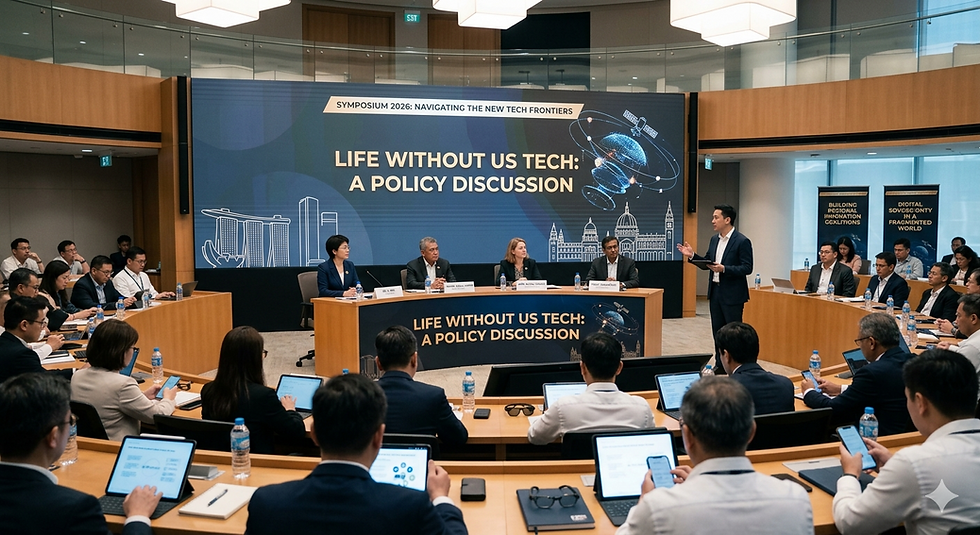
Life Without US Tech: A Policy Discussion
It’s a fascinating—if slightly terrifying—thought experiment that is becoming a very real policy discussion in 2026. If you were to "unplug" from US technology today, the impact wouldn't just be losing your Netflix subscription; it would be a fundamental breakdown of daily life and business infrastructure.
Here is what a world without US tech looks like in 2026:
1. The Financial "Kill Switch"
The most immediate impact is financial paralysis. Most global transactions rely on US-based payment rails.
Credit & Payments: Without Visa, Mastercard, or American Express, international travel becomes a "cash-only" nightmare. Even online shopping would revert to local bank transfers or national systems (like iDEAL or WeChat Pay), severely limiting cross-border trade.
Banking Compliance: As we've seen in recent cases, European and Asian banks are so intertwined with US compliance that they often preemptively "de-bank" individuals or firms at the slightest hint of US regulatory risk to avoid being cut off from the dollar clearing system.
2. The Infrastructure Collapse
US tech isn't just the software you see; it’s the plumbing you don't.
The Cloud: Moving away from AWS, Google Cloud, and Azure would mean local companies losing the ability to scale. While regional alternatives exist, they currently lack the "hyperscale" capacity to support the massive data needs of modern banking, healthcare, and logistics.
Logistics: Major couriers like UPS and FedEx are US-centric. Without them, the global supply chain—especially for high-value components—faces massive delays.
3. The Intelligence & Productivity Gap
In 2026, the "Agentic-First" world is driven by foundation models from companies like OpenAI, Google, and Anthropic.
AI Dependency: Without access to US LLMs, firms lose the "Share of Synthesis." Your ability to automate complex auditing, tax strategies, or legal research drops significantly as regional models (outside of China) are still playing catch-up.
Communication: From Microsoft 365 to Slack and Zoom, the "office" effectively disappears. While local alternatives exist, the loss of interoperability makes global collaboration nearly impossible.
4. The Geopolitical Pivot
For regions like the "Asian Growth Triangle" or the EU, "Life without US tech" is no longer a hypothetical—it’s a risk assessment.
Strategic Autonomy: The EU is currently debating spending upwards of €500bn to build independent satellite and defense tech to remove reliance on US "kill switches."
Regional Alternatives: Countries are aggressively moving toward "Digital Sovereignty," building local data centers and grid connectivity to ensure that a policy shift in Washington doesn't turn off their lights in Singapore or Paris.
The Reality Check: While "de-coupling" is a popular buzzword, the cost of true independence is staggering. For a professional firm today, operating without US tech wouldn't just be slower—it would be a total operational reset.
Do you think the push for "Digital Sovereignty" will actually lead to more regional innovation, or just more expensive, fragmented systems?
Since we last touched on this, the conversation around "Digital Sovereignty" has moved from abstract policy papers to urgent boardroom strategy. In 2026, the prospect of life without US tech is being treated as a critical risk management exercise, specifically for firms operating in the "Asian Growth Triangle" (Singapore, Hong Kong, Malaysia) and Europe.
Here is a deeper look at the specific "choke points" and emerging alternatives as of mid-2026:
1. The Rise of the "Sovereign Cloud"
European and Asian enterprises are aggressively de-risking from the "Big Three" (AWS, Azure, Google Cloud).
The €80 Billion Shift: Spending on sovereign clouds—platforms that guarantee data stays within a specific jurisdiction and is immune to foreign (US) subpoenas—is projected to hit $80 billion this year.
The "Kill Switch" Fear: The concern isn't just about privacy; it’s about continuity. Firms are worried that a shift in US trade policy could lead to "service suspensions" similar to those seen in Russia or under specific export controls.
Emerging Hubs: While the US hyperscalers are still investing $600B annually, Europe's Cloud and AI Development Act (expected H1 2026) is forcing a move toward localized architecture like OVHcloud or regional consortiums.
2. The "Agentic" Alternative
The "Agentic-First" workflow you rely on for auditing and strategy is currently US-heavy, but 2026 is seeing the first viable "B-side" options:
Mistral & Open Source: French-based Mistral AI and various open-source models (Llama 3/4 hosted locally) are becoming the "Gold Standard" for firms that cannot risk sending proprietary tax or legal data to US-based servers.
Vertical AI Agents: Specialized platforms like Cognigy (Germany) or Yellow.ai (India/SE Asia) are replacing generic US chatbots for specific enterprise workflows like HR, procurement, and client onboarding.
3. The Compliance "Patchwork"
Operating without US tech in 2026 creates a massive administrative tax.
Data Residency: You no longer have a "one-size-fits-all" IT stack. You are forced into Regional Modularity—using one stack for your Singapore/Malaysia operations and an entirely different, highly siloed stack for any US-facing work.
Cognitive Debt: Studies show that moving away from unified US suites (like Microsoft 365) to a mix of regional tools increases "cognitive debt"—employees spend 20–30% more time managing the friction between different software ecosystems.
4. The Payment Pivot
If the US financial "rails" (Visa/Swift) were cut off, the "Asian Growth Triangle" is better prepared than most:
mBridge & CBDCs: Project mBridge (involving Hong Kong and Thailand) is now a functional reality for cross-border wholesale payments, bypassing the US dollar-centric SWIFT system.
Interoperable QR: The real-time link between Singapore’s PayNow, Malaysia’s DuitNow, and Hong Kong’s FPS provides a "US-free" corridor for retail and SME transactions.
The 2026 Verdict for Business Leaders
Total independence is currently a billion-dollar luxury. Most mid-sized firms are instead adopting a "1+1" Strategy:
Primary Stack: US-based for efficiency and global "Share of Synthesis."
Shadow Stack: A fully mapped, "cold-start" alternative using regional cloud and open-source AI, ready to be activated if trade relations sour.
Which area of your operations feels most vulnerable to this tech concentration? (e.g., Is it the AI-driven audit tools, or the underlying cloud infrastructure for your regional offices?)
Life Without US Tech: A Policy Discussion


Comments