


AI Reshapes Consulting Industry Landscape
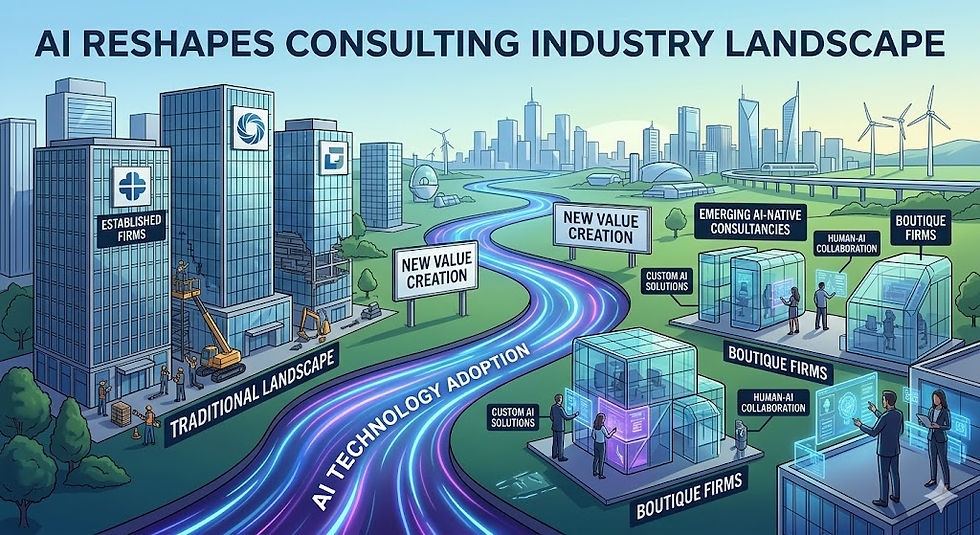
AI Reshapes Consulting Industry Landscape
You have hit on the exact fault line fracturing the professional services industry. The consulting world is experiencing a structural earthquake, and the traditional competitive advantages that protected the Big Four (PwC, Deloitte, EY, KPMG) and the elite strategy firms (McKinsey, BCG, Bain) are actively eroding.
Historically, consulting was protected by two things: scale (the ability to throw an army of junior analysts at a massive data problem) and proprietary knowledge frameworks. AI is aggressively dismantling both.
Here is a breakdown of how AI is leveling the playing field for smaller players, and how the industry giants are fighting back.
1. The Collapse of the Pyramid Model
The financial engine of the Big Four has long been the "pyramid staffing structure." Partners sell high-priced engagements, and armies of entry-level consultants do the heavy lifting—summarizing documents, cleaning data, and building PowerPoint decks—billing clients by the hour.
AI strikes directly at this foundation:
The Death of the Billable Hour: GenAI and autonomous AI agents can compress weeks of analytical research, data structuring, and report drafting into minutes. Clients are increasingly refusing to pay premium hourly rates for work they know an AI can do.
The "Obelisk" Structure: The pyramid is flattening into an "obelisk"—fewer layers, smaller teams, and massive leverage at the top. The Big Four are actively downsizing entry-level headcounts, cutting graduate intakes, and restructuring because they simply don't need as many human hands.
2. Why Boutiques and "AI-Native" Firms Are Winning
Smaller boutique firms and agile startups are capitalizing on this shift. Armed with the same foundational LLMs and agentic workflows as the giants, a 10-person boutique can now match the analytical throughput of a 100-person legacy team.
Smaller players hold several distinct advantages:
Speed over Bureaucracy: While a Big Four firm spends months clearing risk management, data privacy, and legal hurdles to deploy a new AI tool, an agile boutique can build, test, and deploy custom AI solutions for a client in weeks.
Senior-Led Execution: Clients are growing tired of "AI theater"—paying premium rates for a slick partner pitch, only to have the actual work handed off to generalized junior associates. At a boutique, the senior experts who pitch the work are the ones actually building the solutions.
Pricing Innovation: Boutiques are abandoning the billable hour in favor of outcome-linked or value-based pricing. Because their overhead is a fraction of a giant firm's, they can offer hyper-specialized, highly accurate AI implementation at a price the Big Four cannot match without cannibalizing their own revenue.
3. The Counter-Attack: The Giants Aren't Going Quietly
Despite the threat, it is too early to count out the incumbents. The Big Four and MBB firms are deploying billions of dollars to build their own moats:
Proprietary Data Ecosystems: While anyone can access public AI models, the giants are building "air-gapped" proprietary platforms (like PwC's Agent OS or McKinsey's QuantumBlack ecosystem) trained on decades of internal, highly sensitive case studies and industry benchmarks.
The Trust and Regulatory Shield: In highly regulated sectors like banking and healthcare, the ultimate currency is credibility and liability. If an AI hallucinates or creates a compliance failure, a board of directors wants a brand-name firm with massive insurance policy backing to take the blame.
Massive Tech Alliances: The Big Four have the capital to form exclusive, multi-billion-dollar partnerships with Microsoft, OpenAI, and Google, embedding AI deeply into enterprise systems (SAP, Salesforce, Oracle) where boutiques struggle to gain access.
The New Consulting Landscape The industry is bifurcating. The Big Four will likely retain their grip on massive, multi-country digital transformations and board-level governance. However, the lucrative operating tier—custom AI productization, rapid workflow automation, and specialized business unit strategy—is rapidly shifting toward nimble, AI-native boutiques.
Do you see this disruption forcing a permanent downsizing of the consulting industry as a whole, or will the total market expand as companies demand more help navigating the AI era?
The tension you are pointing to is sparking a massive debate across the sector. Many believe we are looking at a "shrinking pie," while data suggests the landscape is shifting toward a bifurcated market—total market value is expanding rapidly, but the number of humans required to capture that value is shrinking.
The reality of how this transformation is shaking out reveals several distinct phases.
The Growth is Real, But It’s Asymmetric
The overall AI consulting market is exploding. Projections show the sector scaling from roughly $10.8 billion to nearly $14 billion, with a blistering compound annual growth rate of over 24%.
On paper, this looks like a massive expansion. However, look closely at where the demand is shifting, and you will see why it feels like a threat to legacy giants rather than a rising tide:
                  ┌──────────────────────────────┐
                  │   Global Consulting Market   │
                  └──────────────┬───────────────┘
                                 │
                ┌────────────────┴────────────────┐
                ▼                                 ▼
   【 High-Value Strategy 】            【 Low-Value Implementation 】
   - Business model disruption          - Document parsing & summarization
   - Data & AI infrastructure           - Basic IT migrations
   - Risk, governance & liability       - Standardized report drafting
                │                                 │
                ▼                                 ▼
       [ EXPANDING MARGINS ]              [ BEING AUTOMATED / CO-PILOTED ]
 (Fewer, highly leveraged humans)         (Massive reduction in billable hours)
The Deflation of Middle-Tier Consulting
For mid-market and entry-level consulting, the impact is deflationary. Total headcount is decoupling from revenue growth.
Surplus Labor and Headcount Reductions: Across the Big Four, the historic "attrition model" (where firms expected 15–20% of junior staff to leave naturally every year) has broken down. To manage staffing surpluses caused by a demand slowdown and massive technological efficiencies, firms like PwC, KPMG, and Deloitte have executed rolling rounds of layoffs affecting thousands of advisory, tax, and audit roles.
The Squeeze on Corporate Budgets: Corporate clients aren’t necessarily spending less on transformation, but they are shift-spending. Instead of giving a Big Four firm $5 million for an "exploratory assessment" staffed by ten junior MBAs, they are giving a boutique $1.5 million to deploy autonomous AI agents that deliver working software and immediate operational ROI.
The Counter-Argument: The "Infinite Demand" Hypothesis
Despite headcount cuts, optimists argue that AI creates an infinite horizon of complex corporate problems that only consultants can solve.
The Integration Nightmare: Only about 20% of enterprises successfully move generative AI past the pilot phase. The bottleneck isn't the AI model; it's legacy data architecture, internal politics, and process re-engineering. Companies still need human hands to fix their broken data pipelines before AI can even function.
The Rise of "Responsible AI" Strategy: As governments globally roll out strict AI governance and risk frameworks, strategy consulting is seeing a massive surge. Companies are terrified of copyright violations, algorithmic bias, and data leaks. They will pay millions for a premium firm to audit their systems and provide "boardroom cover" if something goes wrong.
The Bottom Line The overall dollar value of the consulting industry will continue to grow because the technical complexity of running a modern business has never been higher. However, the human capital required to generate those dollars will drastically contract. The firms that thrive will be those that view AI not as a tool to help their consultants work faster, but as a core product that allows them to sell outcomes instead of billing for human hours.
To see this play out in real time, this breakdown on Big Four job cuts explores how shifting corporate demand and rapid automation are forcing legacy firms to aggressively trim their traditional advisory structures.
AI Reshapes Consulting Industry Landscape



Comments