


Solar
Solar
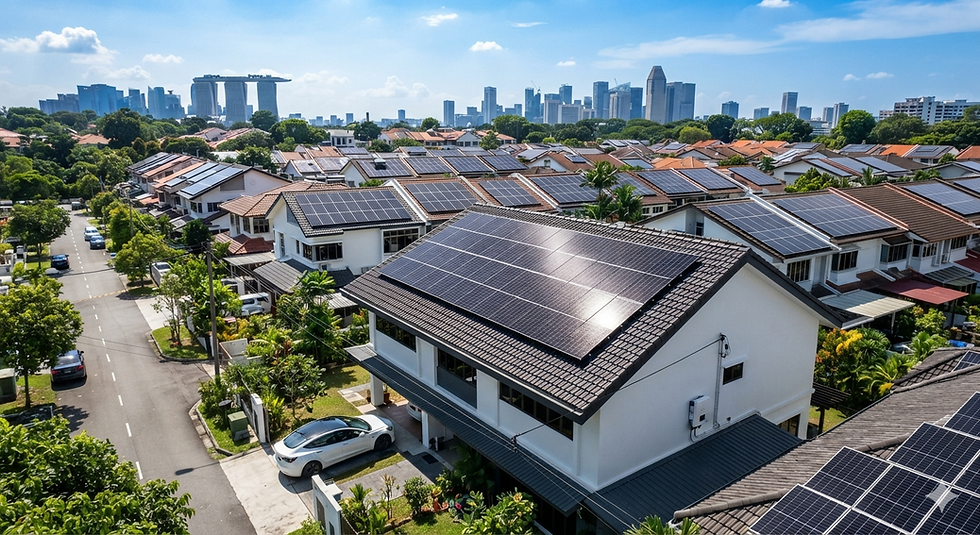
Solar energy is rapidly expanding across Singapore, with local providers like Sembcorp, SolarGy, and Solar Warehouse offering comprehensive photovoltaic (PV) installations for homes and businesses. Driven by the nation's high equatorial solar irradiance and an updated target to deploy 3 gigawatt-peak by 2030, adoption has accelerated from niche technology into mainstream renewable investment.
If you are looking to explore solar options for your property, would you like to know about:
Estimated installation costs for residential or landed homes?
Roof suitability and energy output expectations?
Comparing services from these local providers?
Estimated Installation Costs for Residential or Landed Homes
The total all-in cost for installing solar panels on a residential landed home in Singapore generally ranges from S$15,000 to S$40,000. Most systems average between S$1,200 and S$2,000 per kWp installed. This pricing covers panels, inverter, mounting equipment, wiring, scaffolding, permits, and SP Group grid connections.
Estimated Cost Breakdown by Property Type
The overall pricing varies significantly depending on your roof size and system capacity:
Property Type | Typical System Size | Estimated Cost (SGD) | Approx. Monthly Savings |
|---|---|---|---|
Terrace House | 5 – 7 kWp | S$10,000 – S$16,000 | S$130 – S$180 |
Semi-Detached | 8 – 12 kWp | S$15,000 – S$26,000 | S$220 – S$330 |
Detached / Bungalow | 12 – 20 kWp | S$24,000 – S$45,000 | S$350 – S$650+ |
Good Class Bungalow (GCB) | 25 – 60+ kWp | S$50,000 – S$80,000+ | S$625 – S$1,250+ |
⚠️ Hidden Costs & Component Upgrades
While initial quotes often cover standard setups, certain factors or additions will impact your total investment:
Battery Storage: Optional storage systems like the Tesla Powerwall 2 add an additional S$10,000 to S$13,000 per unit (inclusive of installation). Most high-consumption homes require two units to sustain evening backup power.
Roofing & Scaffolding Complexity: Steeply pitched roofs, concrete roofs, or highly complex architectural structures require advanced scaffolding or heavy mounting components, increasing engineering and labour fees.
Premium Inverters: Upgrading from standard string inverters to individual micro-inverters—which optimize power output when your roof faces partial shading—will add a premium to your quote.
📈 Payback Period & Financial Returns
With retail electricity tariffs averaging around S$0.32 to S$0.35 per kWh, residential solar installations boast an incredibly attractive financial return profile:
Break-Even Timeline: Landed properties typically see a full return on investment (ROI) within 3 to 6 years.
Selling Back to the Grid: Under the simplified credit scheme, any excess power generated during hot afternoons can be automatically exported back to the grid for roughly S$0.26 per kWh, offsetting your nighttime electricity bills.
If you want to look into this for your specific property, let us know:
Your average monthly electricity bill (or average kWh consumption)?
Your roof type (e.g., metal, clay tile, or flat concrete roof)?
We can help estimate the ideal system size and calculate your projected payback period.
Roof Type
Each of the three main roof types found on Singapore landed homes—metal, clay tile, and flat concrete—directly dictates your mounting setup, labor costs, waterproofing risk, and the total number of panels you can safely fit.
📊 Roof Type Comparison for Solar
Roof Type | Installation Complexity | Waterproofing Risk | Space Efficiency | Impact on Cost |
|---|---|---|---|---|
Metal (Standing Seam) | Lowest (Fastest setup) | Zero Risk (No drilling) | High (Follows roof pitch) | Cheapest labor fees |
Clay / Concrete Tile | Moderate (Fragile handling) | Low-Medium (Under-tile hooks) | High (Great natural tilt) | Moderate premium (Tile replacement) |
Flat Concrete (RC) | High (Heavy frames/ballasts) | Medium-High (If drilling) | Lower (Spacing needed for shade) | Higher framing cost |
🔩 1. Metal Roofs (Standing Seam or Kliplock)
Metal roofing is widely considered the gold standard and most cost-effective option for residential solar in Singapore.
Mounting Mechanism: Specialized metal clamps grip onto the raised standing seams of the roof.
Waterproofing: Zero penetration is required. Because installers do not drill any holes into the roof surface, the risk of leaks during intense torrential downpours is entirely eliminated.
Cost Impact: This is the quickest and least labor-intensive option, helping you minimize structural engineering fees.
🧱 2. Clay or Concrete Tile Roofs
Commonly seen in traditional landed estates across Serangoon Garden and Siglap, tile roofs are fully compatible but require delicate handling.
Mounting Mechanism: Installers use a rail-and-hook system. Individual tiles are carefully slid up or notched so stainless steel hooks can attach directly to the structural wooden or metal rafters underneath.
Waterproofing: The tile is placed back down over the hook to shed water naturally. However, tiles over 15 years old are prone to hairline fractures and may require a pre-install structural check.
Cost Impact: Contractors usually build a small buffer into the quote for tile breakage replacement during the physical installation process.
🏢 3. Flat Concrete Roofs (Reinforced Concrete / RC)
Flat RC roofs offer complete layout flexibility but come with unique engineering spatial constraints.
Mounting Mechanism: Panels cannot sit flat against concrete because rainwater will pool on the glass. Installers must build triangular aluminum A-frames to tilt the panels at an optimal 10° to 15° angle for self-cleaning drainage.
Waterproofing: To avoid drilling through your roof's waterproofing membrane, installers use ballasted systems—heavy concrete weights that anchor the frames firmly against Singapore’s sudden wind uplifts.
Space Constraints: Because the tilted rows are elevated, they cast shadows. Installers must leave wide gaps between rows to prevent self-shading, meaning you can fit fewer panels total per square meter compared to a pitched roof.
To map out the exact layout and financial savings for your property, let us know:
Which of these three roof types matches your home?
Approximately how much usable roof space or floor footprint (in square meters or stories) do you have?
Comparing services from local providers
Solar Warehouse Pte Ltd
Solar energy company · 1769 Geylang Bahru, #01-01 Kallang Distripark, Singapore 339703
Sembcorp Solar Singapore Pte Ltd
Solar energy company · 5 Toa Payoh West, #05-01, Singapore 318877
SolarGy Pte Ltd
Solar energy company · 70 Ubi Crescent, #01-12, Singapore 408570
When choosing between Sembcorp Solar, SolarGy, and Solar Warehouse, your choice depends on whether you are looking for an institutional corporate partner, a specialized engineering firm, or a component distributor.
While all three operate extensively within Singapore's renewable energy ecosystem, their business models, target markets, and typical residential engagement frameworks vary significantly.
📊 Provider Core Comparison
Feature / Criteria | Sembcorp Solar Singapore | SolarGy Pte Ltd | Solar Warehouse Pte Ltd |
|---|---|---|---|
Primary Focus | Utility-scale, commercial, & large infrastructure. | Specialized EPC (Engineering, Procurement, Construction). | High-volume solar equipment & component distribution. |
Residential Model | Power Purchase Agreements (PPA) / Corporate leases. | Direct system design, customization, & outright purchase. | Sourcing/Consulting partner for builders & sub-contractors. |
Key Strengths | Infinite corporate backing, long-term operational security. | Highly complex engineering expertise & flawless structural track record. | Direct access to top-tier international hardware brands. |
Best Suited For | Large properties looking for long-term third-party maintenance. | Premium landed homes with unique or complex roofing structures. | Homeowners managing an active renovation via a main contractor. |
🏢 1. Sembcorp Solar Singapore: The Institutional Giant
Sembcorp Solar is a division of Sembcorp Industries, one of Singapore's premier government-linked utilities providers.
The Business Model: They specialize predominantly in massive commercial portfolios, government properties, and floating solar farms. When they handle residential setups, it is often via structured corporate programs or commercial-grade Power Purchase Agreements (PPAs).
Pros: Unmatched institutional longevity. Under a lease or PPA model, they assume full responsibility for performance monitoring, grid synchronization, and long-term asset maintenance.
Cons: Highly bureaucratic processes with rigid minimum capacity guidelines. They are less inclined to take on highly bespoke architectural roof designs or smaller individual terrace properties.
📐 2. SolarGy: The Engineering Specialist
SolarGy is a highly reputable boutique engineering firm that bridges the gap between commercial efficiency and precision residential builds.
The Business Model: Operating as a pure-play solar installer, their core strength lies in custom structural design, overcoming complex shading problems, and execution under strict structural conditions.
Pros: Phenomenal track record for premium engineering workmanship, careful wind-load calculations, and neat aesthetic wiring layouts on high-end properties.
Cons: Because they treat each installation as a custom engineering project, their turnkey pricing commands a slight premium over high-volume residential discount companies.
📦 3. Solar Warehouse: The Component Authority
Unlike the first two, Solar Warehouse functions primarily as an authorized regional equipment distributor rather than an all-in-one residential service contractor.
The Business Model: They supply tier-1 international solar brands (such as REC Solar, Luxor, Jinko, SMA, and Deye) directly to commercial roof developers, project owners, and external electrical contractors.
Pros: If you already have a trusted general contractor or architect managing your home's major structural renovation, sourcing directly through Solar Warehouse guarantees access to factory-certified mounting tracks and premium inverters at exceptional wholesale-leaning value.
Cons: They operate as a supplier and expert technical consultant. They do not typically provide direct, consumer-facing turnkey installation crews for individual residential homes.
Are you leaning toward an outright system purchase to maximize your direct energy savings, or are you hoping to find a provider that supports a no-upfront-cost leasing structure?
Outright System Purchase to Maximize direct Energy Savings
An outright system purchase offers the highest possible return on investment for your solar installation. By funding the system upfront, you retain 100% of the monthly utility savings and receive direct credits from SP Group for exporting excess electricity back to the grid.
When opting for an outright purchase in Singapore, navigating the process effectively involves the following execution roadmap and financial considerations:
Step-by-Step Implementation Roadmap
From your initial decision to full grid activation, the entire turnkey process typically takes 8 to 12 weeks:
Site Assessment & Engineering Design (Week 1–2): The engineering team evaluates your roof structure, checks for nearby shading hazards (such as trees or taller neighboring units), and runs PVsyst simulation software to model your exact annual energy generation.
Contracting & Equipment Procurement (Week 3): You finalize the system capacity (e.g., a 10 kWp system) and lock in your component selections (such as tier-1 solar panels and a reliable string or micro-inverter system).
Regulatory Permitting & SP Group Application (Weeks 4–7): The installer handles all necessary bureaucratic submissions. This includes securing structural clearance from a Professional Engineer (PE), submitting plans to the Building and Construction Authority (BCA) if required, and filing a grid connection application with SP Group.
Physical Installation (Week 8): The physical work on-site is surprisingly fast. Setting up scaffolding, mounting the rails, laying the panels, and running the electrical wiring to your distribution board typically takes only 3 to 5 business days.
Testing, Commissioning, & Meter Turn-On (Weeks 9–12): SP Group visits your property to replace your standard electricity meter with a bi-directional meter. This allows the grid to accurately track both the electricity you consume and the excess solar power you sell back.
💳 Available Financing Options
If you want to maximize your long-term direct energy savings but prefer not to deploy S$15,000 to S$30,000 of liquid cash immediately, Singapore's banking ecosystem offers highly competitive green financing structures:
UOB U-Solar Program: UOB offers dedicated residential green loans with 0% interest installment plans spanning up to 36 months, or competitive flexible loan rates over longer tenures. They partner directly with certified installers to bundle the loan and installation seamlessly.
OCBC Eco-Care Loans: OCBC provides specialized green residential loans featuring preferential interest rates that track lower than standard renovation or personal loans, provided the system meets basic sustainability and energy-efficiency standards.
Standard Renovations Loans: Most major local banks allow you to fold a solar installation into a broader home renovation loan package, which generally carries a significantly lower interest rate than standard personal credit lines.
If you would like to move forward with configuring your specific system, let us know:
Your average monthly electricity bill (in SGD or kWh)?
Your roof type (metal, clay tile, or flat concrete roof)?
We can calculate the ideal system capacity you need and project your exact payback timeline.


Comments